A Journey of Discovery and Cultural Immersion
Originally posted: Sep. 6, 2023
By: COE Communications Staff
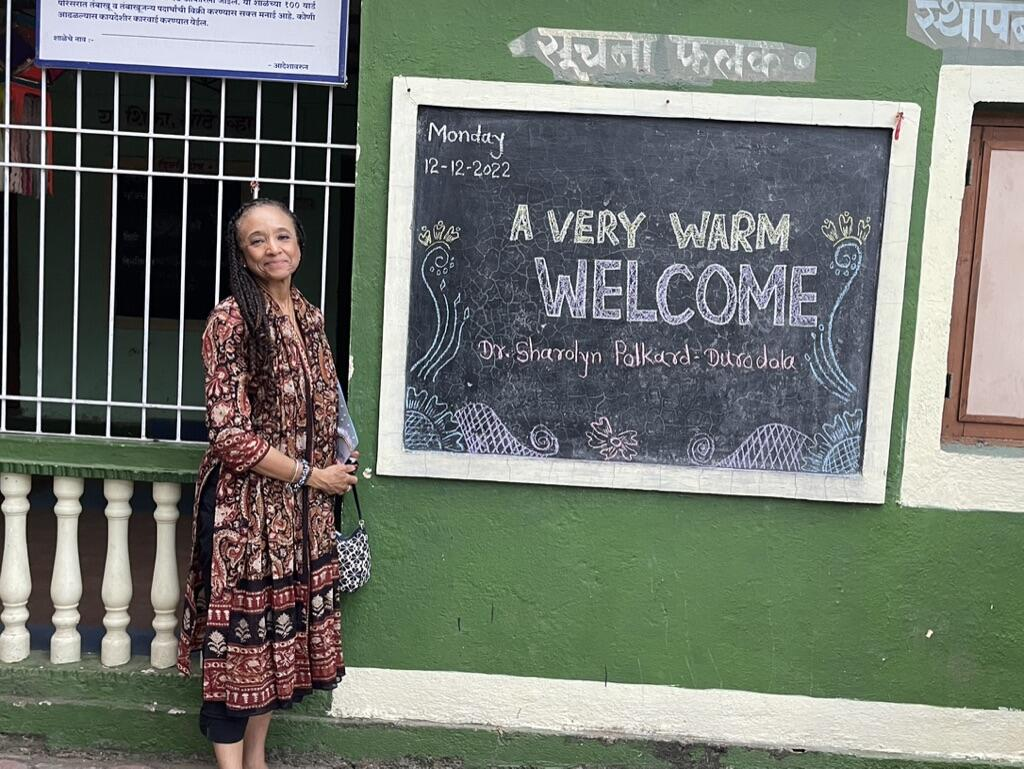
Dr. Sharolyn D. Pollard-Durodola, researcher, professor, and multilingual education expert, traveled to India last fall and returned transformed.
Her mission? To explore the intersection of history, policy and the experiences of Indian educational communities as they pursue multilingualism. Supported by a Fulbright-Nehru Academic and Professional Excellence award, she immersed herself in a new culture uniquely marked by multilingualism and the pursuit to promote it in the early years of formal education.
Over the course of four months, she expanded not only her understanding of the country’s educational landscape but also her sense of self.
Early Inspiration
Sharolyn’s affinity for language learning began long before her sabbatical. Her father, hailing from Texas, traveled between the U.S. and Mexico often. She fondly remembers him owning a Spanish language book that captured her curiosity. “I was always intrigued by the differences in the language and tried to figure out what things meant.” Naturally, when the time came to pick her college major, she chose Spanish and Portuguese.
As a college student, she learned that language acquisition is so much more than being able to translate, write, and speak a new language. She was taught that “If you want to understand people, you have to learn their language.” Even simple knowledge of a language can help us understand the philosophy behind people who speak it. “This concept has been really important in my life,” she shared. “It frames how I understand people, especially people who are different from me.” Sharolyn would later focus her studies on language use within the African diaspora and the consistent political role that language played in colonialism.
Understanding Diverse Cultures, People, and Perspectives
India represents one of the oldest civilizations in the world featuring a diversity of religions, languages, and regions. With over 122 languages, alongside the 22 officially recognized languages, multilingualism is lived out in multi-generational households where children are exposed to several languages before they begin school.
Sharolyn began to see that when a country’s culture places importance on familial linguistic diversity, multilingualism tends to thrive – which is in contrast to the preference for monolingualism embedded in U.S. school systems.
English as a Symbol of Status
During her sabbatical, Sharolyn came to understand that English proficiency for some Indian students was more about perception and status than fluency. On a few occasions, her interview participants would claim they spoke English, using it in their daily and professional lives. However, once in the actual interview or during a school visit, it became clear that the individuals may have had word recognition skills but were not as fluent as they claimed to be.
While under British rule for nearly a century, Indians were introduced to English during colonization as a strategy by the crown to unify the country under one language. English would become associated with intelligence, while mother tongues and vernacular Indian languages were associated with inferiority – which explains when some claim they speak English when they do not.
Building Bridges Across Languages
These values and beliefs are reflected in the language education expectations in India. Indian schools vary in their language teaching methods and goals. Some vernacular medium schools teach all subjects in the local language, while Semi-English schools use English as a gateway to universal subjects, which can sometimes lead to limited English communication skills. English Medium schools teach all subjects in English. Often the goal for Indian students is not necessarily to communicate proficiently in English, which has become a national concern due to the global dominance of the language.
Sharolyn was moved by dedicated teachers in a Semi-English school who created stimulating multilingual learning environments for migrant students from underserved villages. With classrooms full of students speaking at least 10 vernacular languages or dialects each, the teachers prepared bilingual dictionaries to help children connect and learn across languages.
Championing Linguistic Diversity and Personal Growth
Dr. Pollard-Durodola expressed her gratitude for the invaluable experiences and personal growth she gained during her sabbatical in India. She knows her research findings will inform her future work, shaping educational policies and practices that will empower emergent bilingual students. Her commitment to personal growth, advancing educational equity, and a deep respect for local culture, traditions, and practices will serve her well.
Her sabbatical research in India was an expression not just of her career, but her philosophy of being and living in the world. Now, back at UNLV, she’ll continue to unravel the challenges and misconceptions surrounding emergent bilinguals and identify potential solutions that could benefit students around the world.