Early Childhood, Multilingual, and Special Education

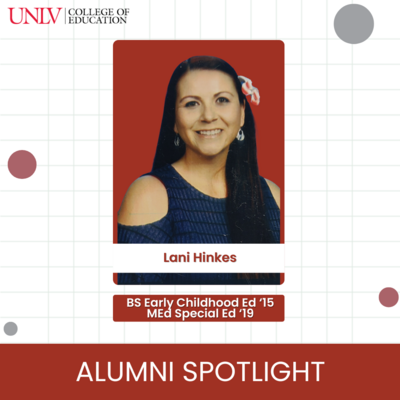
Alumni Spotlight: Lani Hinkes ‘15 ‘19

Originally posted: Jun. 27, 2024

By: COE Communications Staff

Name: Lani Hinkes

Degrees: Class of 2015 B.S. Early Childhood Education, Class of 2019 M.Ed. Special Education

Current Role: Elementary School Teacher at Clark County School District

Why did you choose UNLV? What led you to pursue your degree in education?

I was born and raised in Las Vegas, so UNLV was always the plan for me. Plus, I wanted to graduate from a four-year school. Studying education wasn’t the plan initially; I enrolled as a nursing student but had to shift due to my family. My kids were the ones who got me into the education system, and everything seemed natural when it came to teaching.

What is your current position, and how did UNLV prepare you for your career?

I currently teach second-grade students in the Clark County School District. UNLV prepared me very well and helped me understand how to reach students. What helped the most was the student-teaching experience because it was important to me. I helped students at the College of Southern Nevada with their teaching experience.

What were you involved with at UNLV/What was your proudest moment?

My proudest moment as a Rebel was being inducted into the UNLV Chapter of the National Leadership Honor Society. I was able to accomplish this while studying, working full-time, and raising my five children.

Fun Facts about yourself?

I love kickboxing and weight training because it helps with stress relief. It’s vital to your mental health and making sure you are in the right state of mind.


Are you a COE alum? Let us know what you’ve got going on by submitting a Class Note or getting involved!

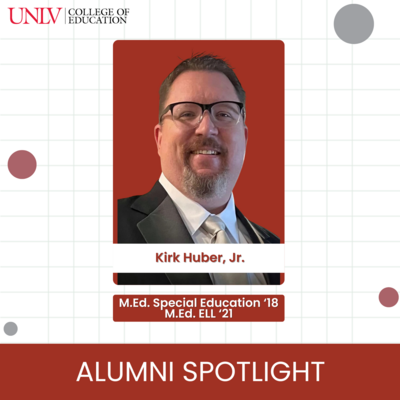
Alumni Spotlight: Kirk Huber ’18 ’21

Originally posted: Jul. 12, 2024

By: COE Communications Staff

Name: Kirk Huber

Degrees: Class of 2018 M.Ed. Special Education, Class of 2021 M.Ed. English Language Learning

Current Role: Educator with Clark County School District

Why did you choose UNLV? What led you to pursue a degree in education?

I decided to move to Las Vegas for some sun after dealing with the harsh winters in my hometown of Chicago. My first job back was a substitute teacher position, and I really enjoyed the profession. So, I decided to enroll at UNLV for my master’s since it was nearby. I first went for a master’s in Special Education because I enjoy working with students with intellectual disability. After completing that degree, I returned to pursue a second master’s in English Language Learning.

How did your experience at UNLV help you find your first position after graduation?

It allowed me to receive endorsements and license requirements needed to teach fully. It also gave me the opportunity to reach a larger audience of students for whom I could advocate.

What is your most prideful moment at UNLV?

Coming from a blue-collar background, I would have never thought I would receive a master’s degree. I also have the privilege of helping adult students with their studies, especially here at UNLV with Project F.O.C.U.S.

What advice would you give to current students at UNLV?

Don’t get bogged down in the stress of all things going on. Take things one at a time!


Are you a COE alum? Let us know what you’ve got going on by submitting a Class Note or getting involved!

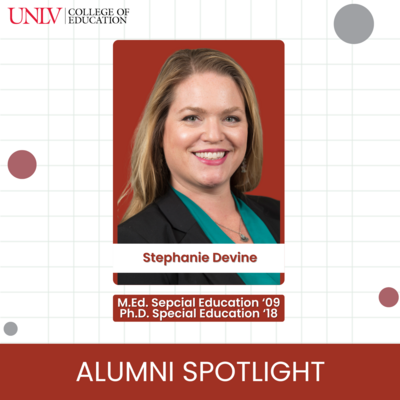
Alumni Spotlight: Stephanie Devine ‘09 ‘18

Originally posted: Sep. 27, 2024

By: COE Communications Staff

Name: Stephanie Devine

Degrees: Class of 2009 M.Ed. Special Education, Class of 2018 Ph.D. Special Education

Current Role: Associate Professor of Special Education at Georgia Southern University

Why did you choose UNLV? What led you to pursue a degree in education/human services?

Choosing UNLV was the most convenient for me because my family was already living here.  I chose to get my degree in special education due to my passion for helping children and adults with intellectual disability.

What advice do you have for current UNLV students?

Don’t be afraid to talk to your professors. Attend their office hours. Make sure you get to know them. Getting to know you encourages them to help you out even more when you ask. Also, do your work!

Why should alumni stay engaged at UNLV?

It’s a great way to network and stay connected with other professionals. It’s also a good way to get inspired or inspire others. Hearing other people’s stories and their accomplishments is a great reminder of why she joined the education field, and it’s a great way to show that there is so much more to education aside from teaching. There’s so much more you can do with an education degree.


Are you a COE alum? Let us know what you’ve got going on by submitting a Class Note or getting involved!

A Journey of Discovery and Cultural Immersion

Originally posted: Sep. 6, 2023

By: COE Communications Staff

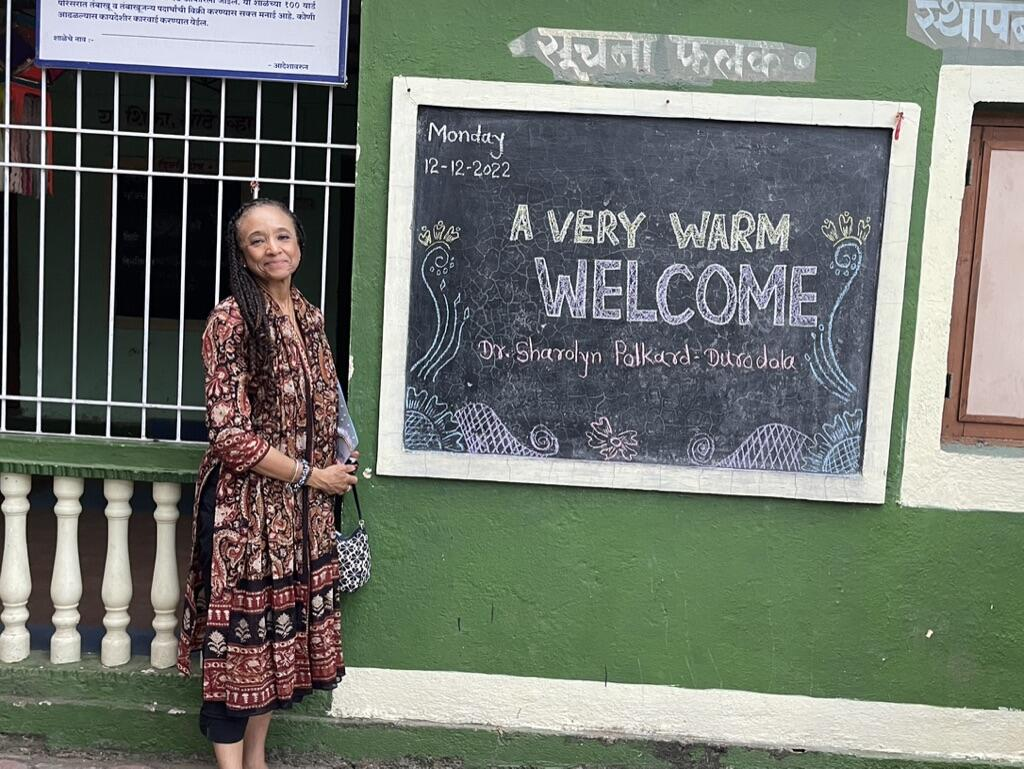
Dr. Sharolyn D. Pollard-Durodola, researcher, professor, and multilingual education expert, traveled to India last fall and returned transformed.

Her mission? To explore the intersection of history, policy and the experiences of Indian educational communities as they pursue multilingualism. Supported by a Fulbright-Nehru Academic and Professional Excellence award, she immersed herself in a new culture uniquely marked by multilingualism and the pursuit to promote it in the early years of formal education.

Over the course of four months, she expanded not only her understanding of the country’s educational landscape but also her sense of self.

Early Inspiration

Sharolyn’s affinity for language learning began long before her sabbatical. Her father, hailing from Texas, traveled between the U.S. and Mexico often. She fondly remembers him owning a Spanish language book that captured her curiosity. “I was always intrigued by the differences in the language and tried to figure out what things meant.” Naturally, when the time came to pick her college major, she chose Spanish and Portuguese.

As a college student, she learned that language acquisition is so much more than being able to translate, write, and speak a new language. She was taught that “If you want to understand people, you have to learn their language.” Even simple knowledge of a language can help us understand the philosophy behind people who speak it. “This concept has been really important in my life,” she shared. “It frames how I understand people, especially people who are different from me.” Sharolyn would later focus her studies on language use within the African diaspora and the consistent political role that language played in colonialism.

Understanding Diverse Cultures, People, and Perspectives

India represents one of the oldest civilizations in the world featuring a diversity of religions, languages, and regions. With over 122 languages, alongside the 22 officially recognized languages, multilingualism is lived out in multi-generational households where children are exposed to several languages before they begin school.

Sharolyn began to see that when a country’s culture places importance on familial linguistic diversity, multilingualism tends to thrive – which is in contrast to the preference for monolingualism embedded in U.S. school systems.

English as a Symbol of Status

During her sabbatical, Sharolyn came to understand that English proficiency for some Indian students was more about perception and status than fluency. On a few occasions, her interview participants would claim they spoke English, using it in their daily and professional lives. However, once in the actual interview or during a school visit, it became clear that the individuals may have had word recognition skills but were not as fluent as they claimed to be.

While under British rule for nearly a century, Indians were introduced to English during colonization as a strategy by the crown to unify the country under one language. English would become associated with intelligence, while mother tongues and vernacular Indian languages were associated with inferiority – which explains when some claim they speak English when they do not. 

Building Bridges Across Languages

These values and beliefs are reflected in the language education expectations in India. Indian schools vary in their language teaching methods and goals. Some vernacular medium schools teach all subjects in the local language, while Semi-English schools use English as a gateway to universal subjects, which can sometimes lead to limited English communication skills. English Medium schools teach all subjects in English. Often the goal for Indian students is not necessarily to communicate proficiently in English, which has become a national concern due to the global dominance of the language.

Sharolyn was moved by dedicated teachers in a Semi-English school who created stimulating multilingual learning environments for migrant students from underserved villages. With classrooms full of students speaking at least 10 vernacular languages or dialects each, the teachers prepared bilingual dictionaries to help children connect and learn across languages.

Championing Linguistic Diversity and Personal Growth

Dr. Pollard-Durodola expressed her gratitude for the invaluable experiences and personal growth she gained during her sabbatical in India. She knows her research findings will inform her future work, shaping educational policies and practices that will empower emergent bilingual students. Her commitment to personal growth, advancing educational equity, and a deep respect for local culture, traditions, and practices will serve her well. 

Her sabbatical research in India was an expression not just of her career, but her philosophy of being and living in the world. Now, back at UNLV, she’ll continue to unravel the challenges and misconceptions surrounding emergent bilinguals and identify potential solutions that could benefit students around the world.

LEARNING THROUGH LANGUAGE: Dunn Community Talks foster key discussions on multilingual learning

Originally posted: Jun. 9, 2025

By: Sakinah Musa

Impactful ideas grow from meaningful conversations. Since last year, the Dunn Community Talks have sparked much-needed dialogues on assessment in multilingual education, creating a lasting impact thanks to the vision and generosity of the Dunn Family Foundation. 

With a focus on addressing assessment concerns in multilingual education across various disciplines, the Dunn Community Talks provide an avenue for educators, researchers, administrators, practitioners, families, and community stakeholders to increase their understanding and build skills to apply knowledge related to multilingual populations in their respective settings. 

Why Assessment in Multilingual Education Matters

“Assessment in multilingual education is crucial because it allows educators to validate identity while testing knowledge,” said  Sharolyn Pollard-Durodola, the Dunn Endowed Chair for Educational Assessment and host of the Dunn Community Talks.  

The choice of topics and selection of expert speakers from across the country highlights the different perspectives from which assessment in multilingual education can be explored. The first two talks hosted in 2024 raised awareness on the best practices for supporting young multilingual learners in early childhood education and the assessment challenges for this population. They also explored how multilingual learners with special needs can be supported, particularly those struggling in reading, science, and social studies.

This year, the talks delved into numerous sides of assessment in multilingual education, from reading assessment for multilingual learners with learning disabilities to the three pillars of developing a multicultural orientation, and lastly, navigating multilingualism in early childhood leadership. 

Combined, the talks have garnered excellent feedback from the participants.

Insights With Lifelong Impact

“As an educator, I believe it is essential to be a lifelong learner,” said Wendy Reyes, a regular participant at the Dunn Community Talks and a Counselor for the Clark County School District (CCSD). 

“Staying informed about current research and best practices allows us to bring up-to-date knowledge to our students and support their success in meaningful ways,” she added.

For Wendy,  the lessons from the series resulted in better connections with families and students. Hearing directly from professionals in the field and community members helps her stay grounded in the realities that families of multilingual learners face, while also strengthening her ability to advocate for her students’ needs. 

The Bedrock of The Series

The Dunn Family Foundation has been supporting UNLV since 2016, focusing on programs that use education to develop a better society and devise innovative ways in which testing and support materials can contribute to educational initiatives. 

The foundation reflects the values of founders Lloyd and Leota Dunn and their son, Douglas Dunn, who now oversees the organization. The Dunn family has been a long-time champion of lifelong learning. Education drives progress in society, and practical assessment and teacher support materials improve educational outcomes. 

By financially supporting the Dunn Family Chair in Educational Assessment, the series continues to grow its reach and deepen its impact on Southern Nevada educators. It also creates a consistent space to include national experts in community-focused conversations. 

What’s Next? 

“I want to maintain an interdisciplinary approach because there are different perspectives from which assessment in multilingual education can be viewed,” Sharolyn said.

An interdisciplinary lens guides the series, fostering intellectual curiosity and growth within and across disciplines. With the success of the Dunn Community Talks, it is clear that the series is becoming a part of not just the College of Education, but UNLV and the greater Southern Nevada community. It is also clear that when supported, conversations like these hold lifelong value. 

Trust your naʻau (gut): How Ikaika Regidor Found His Calling

Originally posted: Aug. 6, 2025

By: Kia Cummings

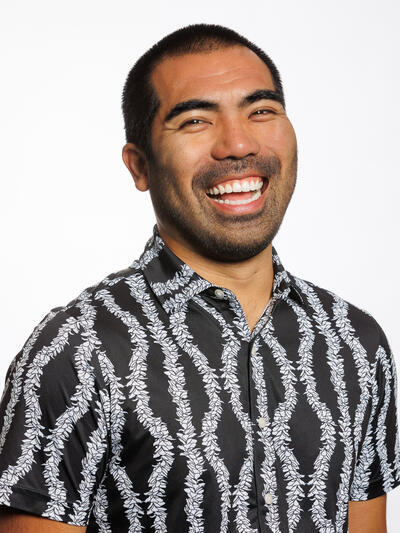
Ikaika Regidor, ‘08 B.S. Early Childhood Education and ‘11 M.S.W. Social Work, didn’t plan to end up at UNLV. In fact, his sights were set on his dream school in Washington. But when it came down to it, UNLV made the most sense financially. 

“In hindsight,” he says, “things really lined up for me in Las Vegas. I don’t know that the same opportunities would’ve emerged if I’d gone somewhere else.”

That practical choice set him on a path from the preschool classroom to the frontlines of advocacy and public health.

Finding His Footing

Like many students, Ikaika didn’t settle into his major right away. He started out studying business, and even gave kinesiology a try. The real turning point came outside of class, through a work-study job at the UNLV/CSUN Preschool. Surrounded by children, educators, and ideas about learning, a spark lit within.

“I joke that I picked early childhood education because I’m short, and I didn’t want to teach middle schoolers taller than me.” Silly as it may sound, it helped guide his decision after a friend pointed out that early childhood education covered birth through second grade. “It felt like the right fit, and the rest started to fall into place.”

Looking back, the UNLV alum credits the preschool and people there with giving him room to grow and figure things out.

“They didn’t tell me what to do. They asked the right questions,” he said. “That space for reflection was a gift.”

A Voice for Inclusion

What began as a switch in majors proved to be a deeper calling. In his classes, Ikaika engaged in conversations around diversity and representation as he also embraced his queer identity.

He noticed that, despite their best intentions, curriculum didn’t always reflect LGBTQ+ families in meaningful ways. So, he got to work, advocating for more inclusive classroom books and better language on school forms, and presented ideas at both local and national education conferences.

“I just wanted the systems we were part of to better reflect the communities we were serving.”

This conviction led him to join various advocacy and affinity groups, serve as a student representative, and later as president of UNLV’s Association for the Education of Young Children.

Going Beyond the Classroom

Since graduating in 2008 and getting a master’s in social work also at UNLV, Ikaika has called several places home, and each has shaped his worldview and his approach to education. 

“Kaimukī [in Hawai’i] grounded me in culture and identity. Vegas gave me space to discover my path. New York sharpened my advocacy. And Honolulu reconnects me with purpose.”

He spent eight years at the Gay, Lesbian & Straight Education Network (GLSEN), a national organization focused on creating safe and inclusive schools for LGBTQ+ youth, rising to the rank of director of education and youth programs. From there, he returned home to Hawai‘i to serve as senior programs director at the YMCA of Honolulu, Nuʻuanu Branch.

Today, he works as the community initiatives program manager at Papa Ola Lōkahi, the Native Hawaiian Health Board, developing public health education materials, tools, and frameworks focused on uplifting the health and well-being of Native Hawaiian communities.

“Education is woven through everything I do, even when I’m not in a traditional classroom,” he said. “Facilitation is education. Whether you’re talking to preschoolers about Rainbow Fish or making public health training more effective, the same principles apply.”

Trusting the Process and Being True to Yourself

Ikaika is ever evolving but lives by these principles: “leave places better than you found them and trust your naʻau—your gut [center of being, ancestral connection, and inner sense of knowing].” Whether it’s a classroom, an organization, a one-on-one conversation, or giving yourself and others permission to change directions, he hopes his work continues to open doors for others.

Holly Salazar: A Passionate Educator on a Fast-Track to Success

Originally posted: Jul. 10, 2025

By: Kelsey Claus

Home-Grown Teachers: Fast-Track Higher Education Expands Opportunities for Rural Communities 

For Holly Salazar, education is a calling. As a dedicated paraprofessional with the Elko County School District, she’s spent years supporting students. Now, through a unique pre-apprenticeship program, she’s taking the next step toward achieving her dream of becoming a full-time teacher.

A Calling Sparked Early in Life


Holly’s passion for teaching was sparked at an early age. At 18, she began working as an assistant teacher at a child care center in Wells, Nevada, thanks to the encouragement of her best friend. From the moment she stepped into the classroom, she was hooked. “I instantly fell in love with it. I loved teaching the kids and watching them grow,” Holly recalls.

Finding Confidence and Community Support

Currently working through general education requirements in the Nevada Forward™ Undergraduate Pre-Apprenticeship Program, Holly is working toward her degree in early childhood education and expects to finish next year. As a full-time working mother, the program’s flexibility has been a game-changer. “Being able to take classes online at my own pace, after work, without having to go to a physical classroom has made all the difference,” she shares.

Holly first heard about the program through her coworkers, and although she initially worried that she might be too old to go back to school, she quickly realized this was the perfect opportunity. “I needed to fast-track my degree so I could become a teacher faster,” she said. In addition to the program’s accelerated timeline, she believes the support system it provides has been invaluable. “The guidance and mentoring offered throughout the program help keep me on track. Life happens, and having that extra support makes it easier to juggle work, school, and family.”


Inspired to Make a Difference

Her decision to pursue teaching isn’t just about personal fulfillment—it’s also about making a difference in the Elko community that she and her daughters love. Holly has her sights set on teaching second grade, a pivotal time when students begin developing a love for learning. “The kids are still sweet, but they’re also starting to come into their own. I love watching that transformation,” she explained.

Beyond her personal goals, Holly recognizes the broader impact of her journey. With the ongoing teacher shortage in Nevada, she hopes to inspire others to follow in her footsteps. “I tell people about this program all the time. It’s an amazing opportunity to earn a degree, receive mentorship, and get the support needed to succeed. And the best part? No student loan debt,” she emphasizes.


Rooted in Community, Driven by Purpose


As she continues her journey toward becoming a licensed teacher, Holly remains a testament to perseverance, passion, and the importance of providing higher education opportunities within rural communities. With her unwavering dedication, she’s not just shaping her own future—she’s helping to shape the future of countless young learners in her community.

Assessment Starts With Teaching: Holmes Scholar Ayo Aborishade Is Reframing Assessment In Special Education

Originally posted: Jun. 2, 2026

By: Sakinah Musa

Low test scores often lead us to believe students are struggling academically. 

But what if certain assessments do not fully measure students’ abilities in the first place? How can we say assessments are accurate if they don’t reflect students’ unique learning styles and cultural backgrounds?

These questions are at the heart of Ayo Aborishade’s doctoral research. 

During her undergraduate studies in Nigeria, she had encountered an assessment task that required the students to tie their shoelaces. However, these students only wore shoes with buckles or Velcro straps. This task was one of numerous assessment items that weren’t contextually relevant. 

“That’s when I realized some of the children weren’t failing because they lacked the ability. The test just wasn’t culturally relevant,” Ayo shared. 

In 2021, when she began her master’s in Special Education at UNLV, the American Psychological Association acknowledged the role of assessment in promoting racial inequities. It became clear to her then that there was a gap. 

“That moment connected my experiences in Nigeria and the U.S. It showed me that this issue is systemic,” she said

Now, Ayo is seeking a way to bridge the gap by examining the cultural validity of assessments.  

From Nigeria to Nevada

Ayo’s interest in education grew from being raised in a family of educators. When her father became disabled from a terminal illness, she decided to connect her passion for education with disabilities by studying Special Education at the University of Ibadan in Nigeria.

In 2019, while presenting at an international conference in Tanzania, she met UNLV professor Monica Brown, who had been the only person in the room to acknowledge the strengths of her presentation. That encounter inspired Ayodele’s interest in pursuing her graduate studies at UNLV. 

“The way she represented UNLV in that space made me want to learn more about the institution,” she said. 

It’s been seven years since, and Ayo is now a third-year doctoral student in Special Education and a Holmes scholar under the mentorship of the Dunn Endowed Chair for Educational Assessment, Sharolyn Pollard-Durodola, who serves as the program’s faculty coordinator.  

Why Assessment Matters

In special education, assessments play a critical role in determining whether students qualify for services, what supports they receive, and, sometimes, even which classroom settings they are placed in.

So, what role does cultural validity play?

A student may struggle on a test not because they are incapable, but because the test assumes experiences, vocabulary, or cultural references that are irrelevant to them. For multilingual students or students from different cultural backgrounds, that disconnect can influence their performance in ways that families and educators may not immediately recognize. This poses a risk of misidentifying students and assigning inaccurate interventions in the classroom.

Ayo’s doctoral research centers on a major gap in special education assessment: the lack of cultural validity. 

By intersecting assessment and culture, Ayo’s research aims to reframe how the abilities of culturally and linguistically diverse students are measured. Her work specifically targets learning disabilities and emotional and behavioral disorders, categories with a disproportionate representation of students of color.

“It raises the question: what’s really being measured?” she noted.

Assessment Starts With Teaching

While Ayo’s research examines assessment in special education, she emphasizes that the issue begins earlier. 

“Assessment starts with teaching,” she said.

This statement also reflects her renewed outlook on education.

“Students come to the classroom not only with learning challenges, but also with their culture. Culture is the lens through which they perceive the world and engage with learning,” Ayo shared. 

 “It is critical to see students’ cultural realities as assets in learning,” she added.

Ayo advocates for classrooms where teachers treat students’ cultural and linguistic identities as assets rather than barriers. When students feel a sense of belonging, they are more engaged and better positioned to succeed in assessments.

As she moves toward her dissertation, Ayo’s next steps include exploring how to prepare teachers to conduct culturally valid assessments.

“I want assessments to see students in their wholeness.”
Butler and Surrain receive 2027 President’s Public Purpose Grants

Originally posted: Jun. 12, 2026

By: Nancy Weaver

Congratulations to Marcedes Butler (Education) and Sarah Surrain (Early Childhood, Multilingual, and Special Education) for receiving 2027 President’s Public Purpose grants. Marcedes received a $15,000 Rian Satterwhite Civic Engagement Partnership Grant for the Homegrown Teacher Pipeline Program in partnership with Silver State Education Foundation. Sarah received a $5,000 Faculty Community-Based Research Partnership Grant for Cultivating “Family Circles”: A New Community Partnership to Support Bilingual Development and Caregiver project with Family2Family.

From Paraprofessional to Future Educator: How Cristal Villalpando Found Her Path

Originally posted: May. 28, 2025

By: Sakinah Musa

“I didn’t know programs like this existed.”

That was Cristal Villalpando’s first reaction when she learned about UNLV’s Nevada Forward Undergraduate Apprenticeship Program. This pathway would allow her to become a licensed elementary teacher without quitting her job, relocating her family from Elko, or taking on student loans. What began as a support role has now grown into the pursuit of her dream–becoming the kind of teacher she once needed. 

Finding Her Path

Cristal began her journey working with English language learners (ELLs) with individualized education plans (IEPs) to receive the additional support they need to succeed in the classroom. There, she discovered her love for working with students. 

“The effort they put into their education despite their struggle with the language barrier stood out to me,” she said. “They also appreciated the help, and it was rewarding for me. That’s when I knew I wanted to become a teacher.”

Now a paraprofessional in the Career and Technical Education (CTE) Department at Elko High School, she’s ready to take the next step in her career – becoming a licensed educator through the apprenticeship program. 

A Welcome Opportunity

Upon receiving an email about the program, Cristal reached out to a colleague to learn more. 

“Once I understood it was fully funded and I could keep working while doing it, I applied immediately.”

After twelve months of flexible learning, she’s about to earn her bachelor’s degree in elementary education this summer and become the teacher she wished she had. 

More than a Career – A Path

Growing up, Cristal didn’t have teachers who looked like her. Being bilingual is part of her motivation to teach and help multilingual students adopt a more complex learning process than their single-language peers. For her, becoming a certified teacher is beyond filling a position– it’s about building relationships with the students through consistency and care.

“Kids need to see familiar faces around for years, as knowing teachers’ reputation can help them feel excited to go to school.”

Cristal also believes her transition from a paraprofessional to a licensed educator is even more critical because it helps with the ongoing teacher shortage in Nevada, especially in the community where she grew up.

“I don’t have any reason to leave Elko, I really like it here, and so do my kids,” she says. “There’s a need for teachers here, and I know other educators here.”

While she’s yet to pick the grade level she’ll teach in next year, she’s already looking forward to building strong and supportive relationships with her students.